

Key takeaways
- Act within 24 to 48 hours. That is when mold can start on wet materials. Fast extraction is the biggest factor in what this costs.
- Most residential water jobs cost a few thousand dollars. LawnStarter's 2026 data puts the national average at $3,250, with typical jobs between $1,270 and $5,376.
- Homeowners policies usually cover sudden water damage, not floods. NFIP flood policies take 30 days to start.
- The FAIR Plan does not cover water damage. You need a separate Difference in Conditions (DIC) policy.
- Insurers have deadlines. 15 calendar days to acknowledge a claim, 40 calendar days after proof of claim to accept or deny it.
- No contractor can legally cover your deductible (Penal Code §551), and any job of $1,000 or more needs a CSLB license.
Water on the floor in California usually means one of three things: a pipe let go under the slab, a storm found a way in, or something upstairs overflowed. Whatever it was, the clock started when the water did. Drywall wicks water upward within hours, hardwood starts to cup within a day or two, and mold can take hold in 24 to 48 hours if the space stays wet.
California Water Damage Restoration is a 24/7 water damage response line for the whole state. One call connects you with a licensed, insured restoration contractor for emergency water removal, structural drying, sewage cleanup, mold remediation and repairs, for homes and businesses from Los Angeles and Orange County to San Diego, the Inland Empire, the Bay Area, Sacramento and the Central Valley. We answer around the clock, make sure the crew documents everything your insurance adjuster will ask for, and tell you what the job should cost before the work starts.
Water in your home right now? Shut off the main water valve if you can do it safely, keep away from outlets in wet rooms, take photos before anything gets moved, and call (213) 533-0446.
Water damage restoration services across California
One call to (213) 533-0446 covers every kind of water loss. Start with the full water damage restoration overview, or jump to the service that matches what happened.
Water Damage Restoration
The full job, from the first call and extraction to drying, documentation and rebuild.
Water Damage Restoration detailsEmergency Water Extraction
24/7 standing water removal from carpet, tile, wood and subfloors, then moisture mapping.
Emergency Water Extraction detailsWater Mitigation and Drying
Air movers, LGR dehumidifiers and daily moisture logs until walls and floors read dry.
Water Mitigation and Drying detailsFlood and Storm Damage
Atmospheric river leaks, creek overflows, burn scar mudflows and flooded garages.
Flood and Storm Damage detailsSewage Cleanup
Category 3 sewer backups and toilet overflows, removed, sanitized and verified.
Sewage Cleanup detailsMold Remediation
Containment, HEPA filtration and removal after hidden leaks, following IICRC S520.
Mold Remediation detailsSlab Leak Water Damage
Wet floors over copper lines under the slab: drying, flooring removal and repair.
Slab Leak Water Damage detailsBurst Pipe and Water Heater Leaks
Supply lines, broken pipes and ruptured water heaters: shut off, extract and dry.
Burst Pipe and Water Heater Leaks detailsEmergency water removal and extraction
Crews pull standing water out with truck-mounted and portable extractors, then go after the water you cannot see: under carpet pad, inside wall cavities, beneath cabinets and in subfloors. Extraction is the cheapest drying there is. Every gallon we pull out with a wand is a gallon the dehumidifiers do not have to pull out of the air over the next three days.
Read more: Emergency water extraction in California.
Structural drying and dehumidification
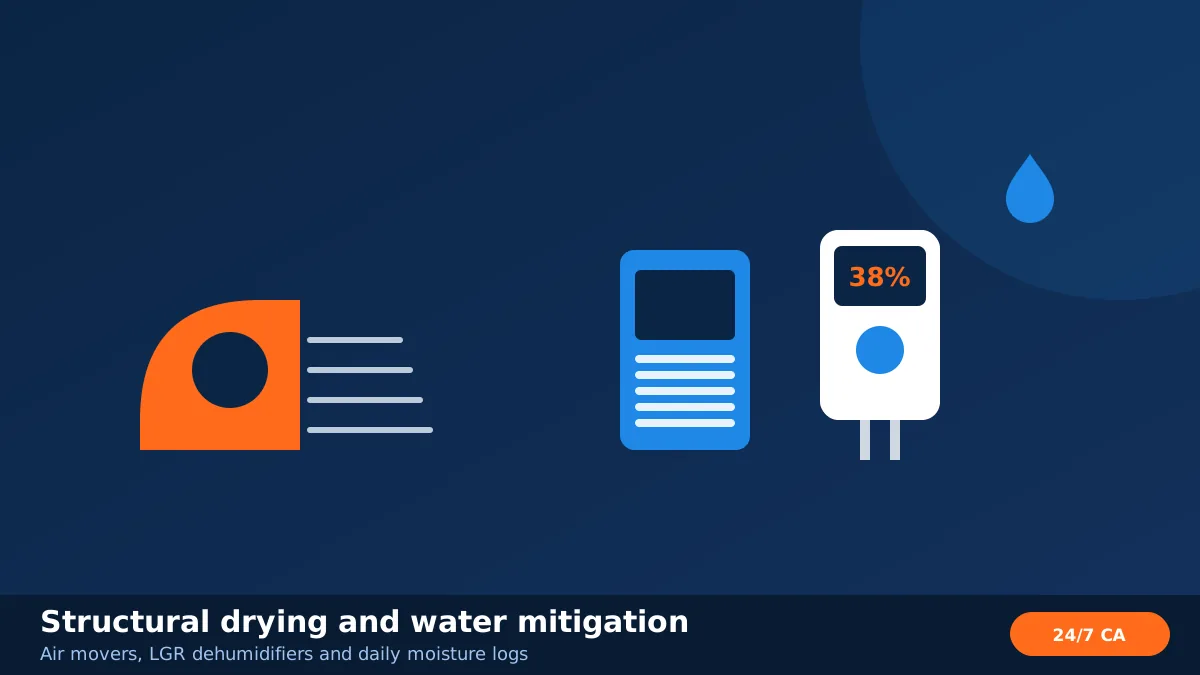
Drying follows the IICRC S500 standard for water damage restoration. Crews set air movers and low grain refrigerant (LGR) dehumidifiers based on the size of the affected area and how wet the materials are, then take moisture readings every day until the framing, drywall and flooring hit dry standards. You get the daily drying log. So does your adjuster.
Read more: Water mitigation and structural drying in California.
Slab leak and burst pipe water damage
Slab leaks are one of the most common water calls in Southern California, especially in homes built on concrete slabs with copper supply lines running underneath. The plumber finds and fixes the pipe. We deal with what the leak left behind: wet tack strip and carpet pad, swollen baseboards, damp drywall, and hardwood or laminate that has started to cup.
Read more: Slab leak water damage and burst pipe and water heater leaks.
Flooded basement, crawl space and garage cleanup
California has fewer basements than Chicago, but plenty of crawl spaces, below-grade garages, hillside lower levels and older Bay Area and Sacramento homes with partial basements. Water that sits in a crawl space raises humidity in the whole house and feeds mold on the underside of the subfloor. We pump it out, dry the soil and framing, and treat what needs treating.
Sewage cleanup and Category 3 water
Sewage backups, toilet overflows with waste, and outside floodwater are all treated as Category 3 water under IICRC S500. That means protective equipment, removal of porous materials the water touched, antimicrobial treatment and verification before anything goes back together. Storm surges in the sewer system are a common cause of backups during atmospheric river events.
Read more: Sewage cleanup in California.
Storm and flood damage cleanup
When an atmospheric river parks over the coast, crews see roof leaks, window and slider leaks, wind-driven rain through stucco, mud in garages and water in homes along creeks and storm channels. We tarp, extract, dry and document so you can file a clean claim.
Read more: Flood and storm damage restoration in California.
Mold remediation after water damage
If the water sat too long, or the leak was hidden behind a wall, mold may already be there. Crews contain the area, run HEPA air scrubbers, remove what cannot be cleaned and follow the IICRC S520 standard for mold remediation. If you need independent clearance testing, you will be told so up front, and the crew will work with your inspector.
Read more: Mold remediation in California.
Repairs and reconstruction
Once the structure is dry, the drywall, baseboards, paint, cabinets and flooring go back in. One team from the first call to the final walkthrough means no gap between the drying company leaving and a contractor showing up.
Commercial, multifamily and HOA water damage
Restaurants, offices, retail, apartment buildings and condo associations all need fast response with minimum downtime. Crews work with property managers and HOA boards, coordinate with building engineers, and keep tenants informed.
California water damage at a glance
| What you need to know | The California picture |
|---|---|
| When the risk peaks | The rainy season runs roughly October through April. The state's water year runs October 1 to September 30. |
| How much rain "normal" is | Downtown Los Angeles averages about 14.25 inches a year, which is why one big storm can do so much damage. |
| Recent storms that flooded homes | San Diego, January 22, 2024. Los Angeles, February 4 to 5, 2024. Southern California atmospheric rivers in November and December 2025. Another atmospheric river in November 2026 brought evacuation warnings near Los Angeles burn scars. |
| Typical cost of a water job | About $1,270 to $5,376 nationally, with a $3,250 average (LawnStarter 2026). California city estimates that include repair often land between $12 and $23 per square foot. |
| Insurance claim deadlines | Insurer acknowledges within 15 calendar days and accepts or denies within 40 calendar days of proof of claim. |
| Flood insurance | NFIP policies normally start 30 days after purchase. |
| FAIR Plan | Does not cover water damage. You need a separate DIC policy. |
| Emergency price protection | After a declared emergency, Penal Code §396 caps price increases for repair, reconstruction and emergency cleanup at 10 percent for 180 days. |
| License requirement | Jobs of $1,000 or more, or any job that needs a permit, require a CSLB license. |
What actually causes water damage in California homes
Every region has its own patterns, but these are the causes behind most California water calls.
Slab leaks under concrete foundations
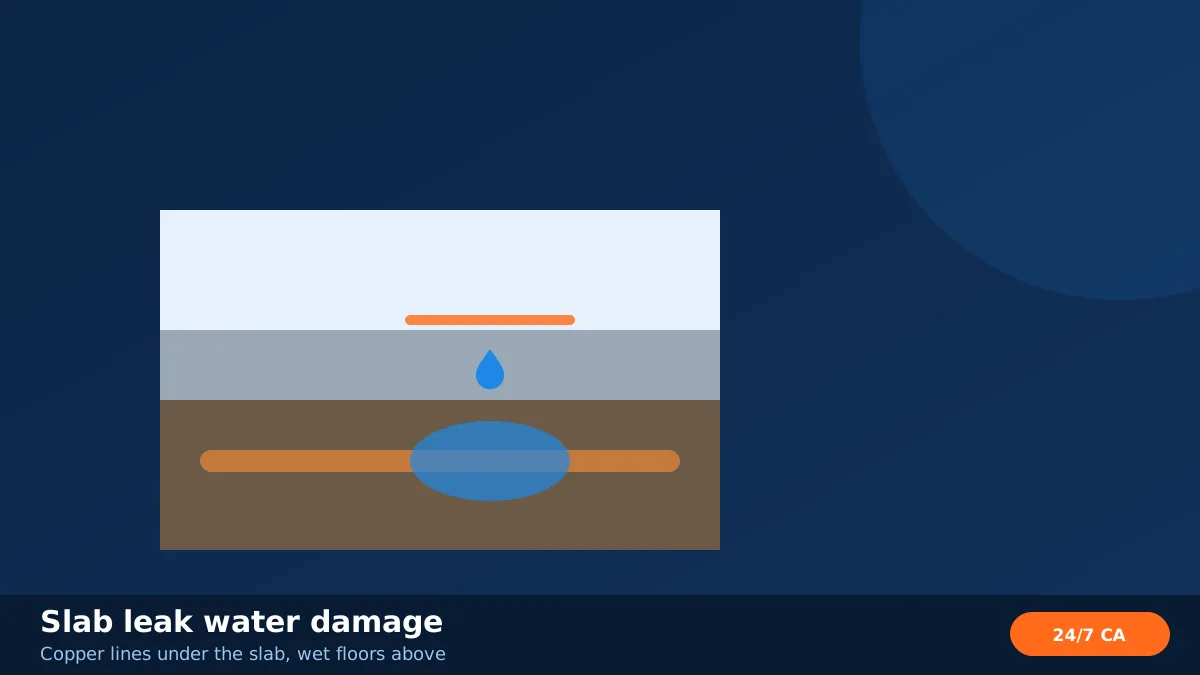
A huge share of homes in Los Angeles, Orange County, the Inland Empire and San Diego sit on concrete slabs with copper water lines running underneath or through the slab. Over decades, those lines can wear through from abrasion, water chemistry and soil movement. Signs to watch for:
- A warm spot on the floor (a hot water line leaking under the slab)
- The sound of running water when every fixture is off
- A water bill that jumps for no reason
- Damp carpet or a musty smell along one wall
- New cracks in tile, or hardwood that starts to cup in one area
The plumber decides whether to repair the line in place or reroute it through the walls or attic. Either way, the restoration crew dries what got wet. Ask your plumber for the leak location and a written description of the repair. Your adjuster will want it.
Failed supply lines, water heaters and appliances
Washing machine hoses, toilet supply lines, refrigerator ice maker lines, dishwashers and water heaters cause a large share of sudden indoor water losses everywhere, and California is no exception. A few California-specific points:
- Water heaters must be strapped. California Health and Safety Code §19211 requires all new, replacement and existing residential water heaters to be braced, anchored or strapped against earthquake motion. An unstrapped tank that tips in a quake can tear its water and gas lines.
- Garage and attic installs hide leaks. Water heaters in garages often leak into the garage slab and then into the house through the shared wall. Attic installs can bring a ceiling down.
- Braided steel lines are not forever. Replace washer and toilet supply lines on a schedule, not when they fail.
Atmospheric river roof, window and stucco leaks
Southern California homes are built for sun, not for days of sideways rain. During an atmospheric river, water finds:
- Flat and low-slope roofs with ponding water
- Failed flashing at chimneys, skylights and roof-to-wall joints
- Sliding glass doors and older aluminum windows
- Cracks in stucco and missing weep screed at the base of walls
- Clogged gutters and downspouts that dump water against the foundation
Many of these leaks show up as a brown ceiling stain or a damp baseboard a day after the storm. Do not wait for the next storm to deal with it. Wet insulation and drywall stay wet.
Burn scar debris flows and mudflows
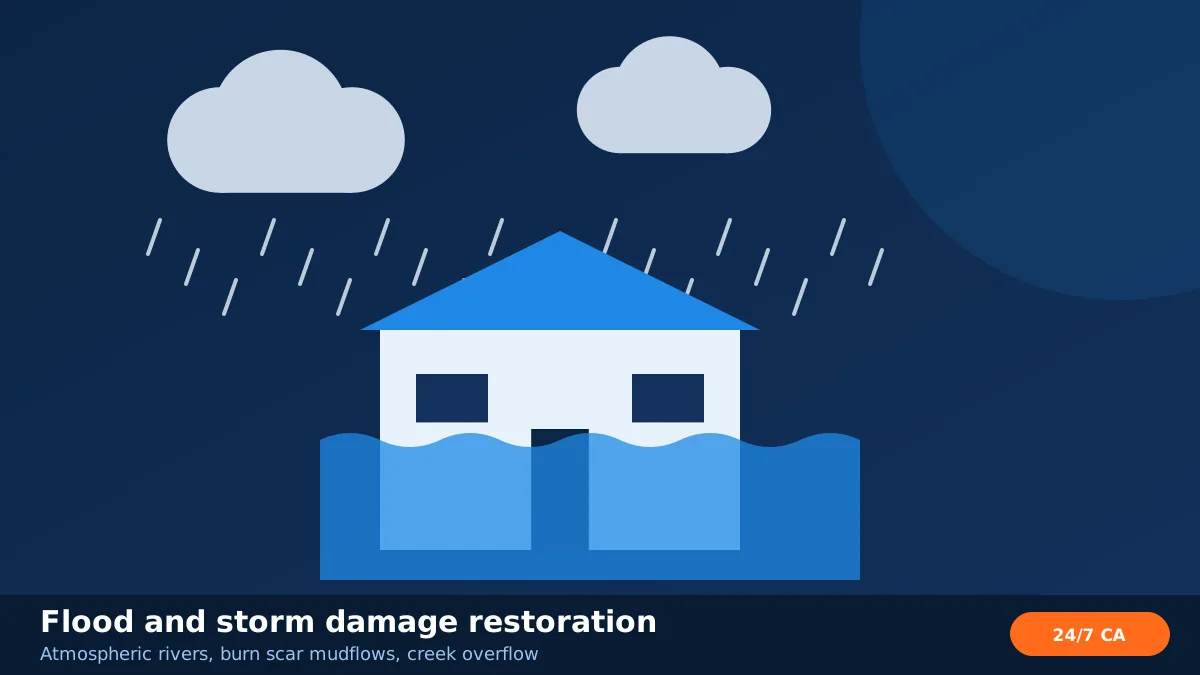
After a wildfire, burned hillsides shed water and debris far faster than normal. Homes below the Palisades and Eaton burn areas, and below scars in Orange County, the Inland Empire and the Central Coast, face mud and debris in garages, yards and lower floors during heavy rain. In November 2026 Los Angeles County issued evacuation warnings near the Palisades, Hurst and Sunset burn scars ahead of an atmospheric river. Debris flow damage is messy, often Category 3, and often an insurance gray area between flood and mudflow coverage. Read your policy before the rain, not after.
Creek, channel and levee overflows
A lot of California water runs in concrete channels that look harmless nine months of the year. When they overtop, homes next to them flood fast:
- Chollas Creek, San Diego. On January 22, 2024, the channel overflowed and flooded homes in Southcrest and nearby neighborhoods.
- Coyote Creek, San Jose. In February 2017, flooding from the creek forced the evacuation of about 14,000 residents, with the Rock Springs neighborhood hit hardest.
- Pajaro River, Monterey County. In March 2023, a levee breach flooded the town of Pajaro and displaced about 1,700 residents.
Rising water from outside is flood, not a covered "sudden and accidental" water loss, under most homeowners policies.
Sewer backups during storms
Heavy rain can push water into the sewer system faster than it can drain, and the lowest drain in your house becomes the overflow point. That might be a garage floor drain, a downstairs shower or a ground floor toilet. A backwater valve on the sewer lateral is the best prevention. Sewer backup coverage is usually a separate endorsement, so check whether you have it.
Attic AC condensate lines and fire sprinklers
In much of Southern California and the Central Valley, the HVAC air handler sits in the attic. When the condensate line clogs or the drain pan rusts through, water comes through the ceiling, often in summer when nobody expects a leak. In condos and newer homes, a fire sprinkler head that is struck, frozen or defective can release a lot of water in minutes.
Condo and multifamily leaks from above
In condos and apartments, the water often starts in someone else's unit. Who pays depends on the HOA's CC&Rs, the master policy and each owner's HO-6 policy. The crew documents the source, the path the water took and every affected unit, so the association, owners and insurers can sort out responsibility without the drying waiting on them.
Irrigation and hillside drainage
Broken irrigation lines, overwatered slopes and poor grading send water against foundations and into crawl spaces, especially on hillside lots. It is slow damage, which matters for insurance, because gradual seepage is usually excluded.
Signs of hidden water damage you should not ignore
A lot of California water damage is found late, because the leak is under a slab, inside a wall or in an attic nobody visits. These are the signs that call for a closer look:
- A musty or earthy smell in one room or closet that does not go away after cleaning
- Paint that bubbles or peels, or drywall that feels soft when you press it
- Baseboards that swell, split or pull away from the wall
- Hardwood or laminate that cups, crowns or buckles in one area
- Brown rings or yellow stains on the ceiling, especially under a bathroom, an attic air handler or a flat roof
- Grout that stays dark around a shower or tub long after the last use
- Carpet that feels damp near an exterior wall after rain
- Your water meter dial moving with every fixture in the house turned off
- Higher humidity indoors, condensation on windows on dry days, or new allergy symptoms at home
If you notice one of these, take photos, note the date and call (213) 533-0446. A moisture meter and a thermal camera can usually tell within an hour whether there is active water behind the surface, and finding it early is what keeps a small leak from becoming a mold job.
Water damage risk by California region
California is not one market. A 1920s craftsman in Sacramento and a 1990s tract home in Irvine fail in completely different ways. Here is what crews see by region. Each major metro also has its own local page with ZIP codes, utilities and neighborhood risks.
Water damage restoration in Los Angeles
Valley slab leaks, hillside drainage, atmospheric river roof leaks and burn scar mud.
Los Angeles service areaWater damage restoration in San Diego
Storm channel overflow, sewer backups, coastal dampness and slab leaks.
San Diego service areaWater damage restoration in San Jose
Coyote Creek and Guadalupe River flooding, Eichler slab leaks and burst pipes.
San Jose service areaWater damage restoration in San Francisco
Old galvanized pipe, garages below living space, combined sewer backups and fog.
San Francisco service areaWater damage restoration in Sacramento
Levee-protected neighborhoods, crawl spaces, tree-root sewer backups and summer AC leaks.
Sacramento service areaWater damage restoration in Fresno
Triple-digit heat AC leaks, swamp coolers, water heaters and winter storm runoff.
Fresno service areaWater damage restoration in Long Beach
Coastal flooding, king tides in Naples and the Peninsula, older bungalows and condo leaks.
Long Beach service areaWater damage restoration in Oakland
Craftsman and Victorian pipe leaks, hillside drainage, basements and sewer laterals.
Oakland service areaWater damage restoration in Irvine
1970s slab leaks in Woodbridge and University Park, attic AC leaks and HOA condos.
Irvine service areaWater damage restoration in Riverside
Summer heat AC leaks, monsoon storms, Wood Streets bungalows and Orangecrest slab leaks.
Riverside service areaWater damage restoration in Bakersfield
Extreme summer heat leaks, water heaters, slab homes and Kern River high water.
Bakersfield service areaWater damage restoration in Anaheim
Postwar slab leaks, Anaheim Hills drainage, Santa Ana River risk and resort-area condos.
Anaheim service areaSee all 100 California city pages
Los Angeles County and the San Fernando Valley
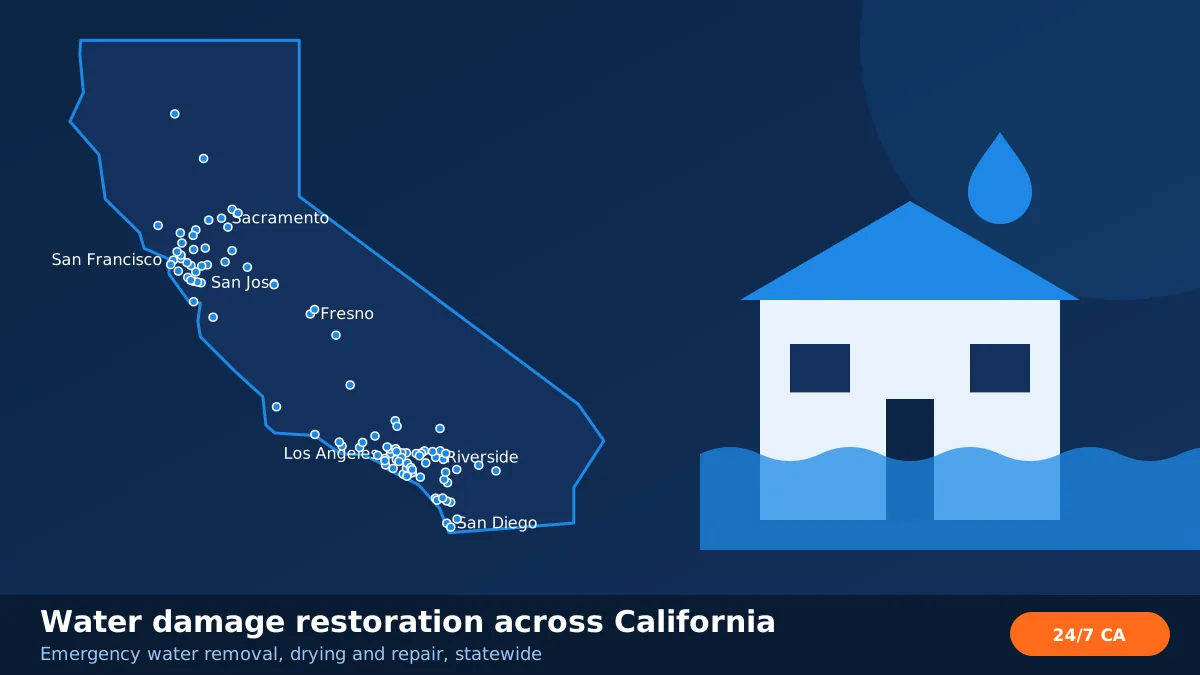
Areas and ZIP codes: Downtown and Silver Lake, Santa Monica (90401), Beverly Hills (90210), Pacific Palisades (90272), Altadena (91001), Pasadena (91101), North Hollywood (91601), Sherman Oaks (91403), Van Nuys, Woodland Hills and Long Beach (90802).
Landmarks and waterways that matter: The Los Angeles River and the Sepulveda Basin, Ballona Creek, the Arroyo Seco, and the hillside canyons from the Santa Monica Mountains to the San Gabriel foothills.
Housing stock: Prewar Spanish and craftsman homes with galvanized or early copper plumbing, postwar Valley tract homes on slabs, hillside homes with retaining walls, and a lot of multifamily buildings and condos.
What crews see most: Slab leaks in the Valley, roof and window leaks during atmospheric rivers, hillside drainage problems, and mud and debris near the Palisades and Eaton burn scars. During the February 2024 storm, the National Weather Service recorded 7.03 inches of rain in downtown Los Angeles over two days, nearly half the city's average yearly total, and the Los Angeles River near Sepulveda Dam reached one of its highest flows on record.
Local guides: water damage restoration in Los Angeles and Long Beach.
Orange County
Areas and ZIP codes: Costa Mesa (92626, 92627), Newport Beach (92660, 92663) and Balboa Island (92662), Huntington Beach (92648), Irvine (92618), Anaheim, Santa Ana, Mission Viejo and Trabuco Canyon (92679).
Landmarks and waterways that matter: The Santa Ana River, Newport Harbor and the Back Bay, San Diego Creek, and the canyons of the Santa Ana Mountains.
Housing stock: Large tracts of 1960s and 1970s slab homes with copper plumbing, master-planned communities with HOAs, and coastal homes and condos close to the water.
What crews see most: Slab leaks, attic AC condensate overflows, HOA drainage disputes, low-lying coastal flooding during winter king tides, and debris flow risk below canyon burn areas. In December 2025 residents around the Airport Fire burn scar were ordered to evacuate during an atmospheric river.
Local guide: water damage restoration in Irvine.
San Diego County
Areas and ZIP codes: Southcrest, Shelltown and Mountain View (92113), Mission Valley (92108), Pacific Beach (92109), downtown (92101), the Tijuana River Valley (92154), plus Chula Vista, Escondido and Oceanside.
Landmarks and waterways that matter: Chollas Creek, the San Diego River through Mission Valley, and the Tijuana River.
Housing stock: Older single-story homes in the southeastern neighborhoods, coastal cottages and condos, and newer tract homes inland.
What crews see most: Flash flooding when storm channels overflow, sewer backups, and roof leaks in homes that rarely see heavy rain. On January 22, 2024, the city recorded 2.73 inches of rain in 24 hours, which it described as the highest level since 1850. Floodwater along Chollas Creek reached the ceilings of some homes, and about 5,000 structures were reported damaged.
Local guide: water damage restoration in San Diego.
Inland Empire
Areas and ZIP codes: Riverside (92501), San Bernardino, Rancho Cucamonga (91730), Ontario, Fontana, Temecula, and mountain and foothill communities such as Lytle Creek (92358) and Wrightwood (92397).
Landmarks and waterways that matter: The Santa Ana River, Lytle Creek, and the San Bernardino and San Gabriel mountains.
Housing stock: Newer tract homes on slabs, older ranch homes in Riverside and San Bernardino, and mountain cabins with crawl spaces.
What crews see most: Monsoon and winter flash flooding, debris flows in foothill communities, slab leaks and attic condensate leaks in the summer heat. In December 2025, flooding and mudslides in Wrightwood buried and flooded homes, and Lytle Creek was ordered to evacuate.
Local guide: water damage restoration in Riverside.
San Francisco Bay Area and San Jose
Areas and ZIP codes: San Francisco's Sunset (94122) and Mission (94110), Oakland (94611), Berkeley (94704), San Jose's Willow Glen (95125), and neighborhoods along Coyote Creek and the Guadalupe River.
Landmarks and waterways that matter: Coyote Creek, the Guadalupe River, San Francisquito Creek, and the bay shoreline.
Housing stock: Victorians and Edwardians with old galvanized plumbing, homes with garages and partial basements below the living space, crawl-space foundations, and dense condo and apartment buildings.
What crews see most: Old pipe failures, water in below-grade garages and lower units, chronic dampness in foggy western neighborhoods, crawl space moisture, and creek flooding. The 2017 Coyote Creek flood remains the reminder that a creek can overtop in a matter of hours.
Local guides: San Francisco, Oakland and San Jose.
Sacramento and the Delta
Areas and ZIP codes: Downtown and Midtown (95814), East Sacramento (95819), Land Park (95818), Natomas (95834, 95835), plus West Sacramento, Elk Grove and the Delta towns.
Landmarks and waterways that matter: The confluence of the Sacramento and American rivers, Folsom Dam, and the levee system that protects much of the city.
Housing stock: 1920s and 1930s bungalows with raised foundations and crawl spaces in older neighborhoods, and newer slab homes in Natomas and the suburbs.
What crews see most: Crawl space water, roof leaks during long winter storms, aging pipes in older homes, and summer AC condensate leaks. Much of the region relies on levees, so flood insurance is worth a serious look even outside the highest-risk zones.
Local guide: water damage restoration in Sacramento.
Central Valley
Areas and ZIP codes: Fresno (93704, 93721), Bakersfield (93301), Visalia, Merced and Modesto.
Landmarks and waterways that matter: The Kings, Kaweah, Tule and Merced rivers, and the Tulare Lake basin, which reappeared during the 2023 floods.
Housing stock: Slab homes, older ranch homes, and rural properties on wells and septic systems.
What crews see most: Attic AC condensate leaks in triple-digit summers, water heater failures, septic backups after heavy rain, and river flooding in wet years.
Local guide: water damage restoration in Fresno.
Central Coast
Areas and ZIP codes: Santa Cruz (95060), Watsonville (95076), Monterey, San Luis Obispo, Santa Barbara (93101) and Montecito (93108).
Landmarks and waterways that matter: The San Lorenzo River, the Pajaro River, the Salinas River, and the creeks that run from the Santa Ynez Mountains through Montecito.
Housing stock: Older beach cottages, hillside homes, and farmworker housing in the Pajaro and Salinas valleys.
What crews see most: River and levee flooding, debris flows below burn areas, and coastal moisture problems. The January 2018 Montecito debris flow and the March 2023 Pajaro levee breach both show how fast water and mud move here.
North Coast and the Russian River
Areas and ZIP codes: Guerneville (95446), Monte Rio, Santa Rosa and the Sonoma and Napa river towns.
What crews see most: Repeat river flooding along the Russian River, crawl space water, and mold in homes that stay damp after floodwater recedes.
Not sure how your area is affected? Call (213) 533-0446 and tell us your ZIP code. We route your call to a licensed crew that works your area.
Call (213) 533-0446California's water disasters: a short history that still shapes your home
California's flood history explains a lot about why homes and neighborhoods are built the way they are, and why some areas flood again and again.
1861 to 1862: The Great Flood
Weeks of storms turned much of the Central Valley into an inland sea and put Sacramento under water. The flood is a big reason Sacramento raised its downtown streets and built the levee system the region still depends on.
1938: The Los Angeles flood
A massive March storm flooded large parts of Los Angeles, Orange and Riverside counties. The response was the concrete Los Angeles River and the flood control channels and basins that crisscross Southern California today. Those channels protect most homes, but the ones right next to them are still the first to flood when a channel overtops.
2017: Oroville Dam and Coyote Creek
Damage to the Oroville Dam spillways in February 2017 forced large evacuations downstream. The same month, Coyote Creek flooded San Jose and about 14,000 residents were evacuated.
2018: Montecito debris flow
On January 9, 2018, heavy rain on the Thomas Fire burn scar sent a debris flow through Montecito. It is still the clearest example of what rain on a fresh burn scar can do.
2023: Pajaro and Tulare Lake
A March 2023 atmospheric river breached the Pajaro River levee and flooded the town of Pajaro. In the southern San Joaquin Valley, the long-dry Tulare Lake reappeared and flooded farmland.
2024: San Diego and Los Angeles
San Diego's January 22 storm flooded homes along Chollas Creek. Two weeks later, the February 4 to 5 storm dropped 7.03 inches on downtown Los Angeles in two days.
2025: Wildfires, then rain
The January 2025 Palisades and Eaton fires left large burn scars above Los Angeles neighborhoods. In late December 2025, atmospheric rivers brought a state of emergency for Los Angeles, Orange, Riverside, San Bernardino, San Diego and Shasta counties, and gave downtown Los Angeles its wettest Christmas season in 54 years.
2026: Burn scar warnings and insurance pressure
In November 2026 another atmospheric river brought evacuation warnings for neighborhoods near the Palisades, Hurst and Sunset burn scars. At the same time, FAIR Plan enrollment kept growing as private insurers pulled back, which leaves more homeowners without water damage coverage unless they buy a DIC policy.
What to do in the first hour after water damage
This is the same checklist our dispatchers walk callers through on the phone.
- Make it safe. If water is near outlets, cords or the electrical panel, do not walk through it. Turn off power to the affected area at the breaker only if you can reach the panel without standing in water.
- Stop the water. Close the main shut-off valve. In most California homes it is near the front hose bib, in the garage, or in a box at the curb by the meter. For a water heater, close the cold supply valve on top of the tank.
- Call a plumber for an active leak. We can point you to one, but the leak has to be fixed before drying can finish.
- Photograph and video everything before you move it. Shoot wide shots of every room, close-ups of damage, the source of the leak and any water line on the walls.
- Move what you can. Lift furniture legs onto foil or wood blocks, pull rugs, and get electronics, documents and photos to a dry room.
- Do not use a household vacuum on water. It is a shock hazard and it will not get the water out of the pad or the walls anyway.
- Call your insurer and start the claim. Write down the claim number, the adjuster's name and every call.
- Call (213) 533-0446. The sooner extraction and drying start, the smaller the job and the stronger your claim.
If the water came from a sewer backup or outside floodwater, keep children and pets out of the area. Treat it as contaminated.
How water damage restoration works, step by step
1. Emergency response and inspection
The crew arrives, confirms the source is stopped and walks the property with moisture meters and a thermal imaging camera. Thermal imaging shows temperature differences that point to wet areas behind walls and under floors. They then confirm what is wet with meters before we cut or remove anything.
2. Classify the water and the damage
The crew identifies the category of water (clean, gray or black) and the class of damage (how much material got wet and how hard it will be to dry). Those two calls drive the whole plan, including what can be saved and what must come out.
3. Extract and remove
Standing water comes out first. Then the crew decides on carpet and pad, baseboards and the lower section of drywall. With clean water and fast response, carpet can often be saved. With sewage or floodwater, porous materials it touched generally have to go.
4. Set drying equipment
Air movers, LGR dehumidifiers and, when needed, specialty systems for hardwood floors or wall cavities. The goal is to dry the structure, not just the surface.
5. Monitor every day
The crew takes readings daily, adjusts equipment and logs the results. Most structures dry in about three to five days, depending on materials and how wet they got.
6. Clean, sanitize and treat
Affected areas are cleaned and treated with antimicrobials where appropriate. Category 3 jobs get extra cleaning and verification.
7. Repair and rebuild
Drywall, insulation, baseboards, paint, flooring and cabinets go back in once everything reads dry.
8. Final walkthrough and documentation
You get the final moisture readings, photos and drying logs. Keep them. If you sell the home, they show the water loss was handled properly.
Water categories and damage classes, explained
Adjusters and restoration companies use these terms, so it helps to know them.
| Category | What it is | Common California sources | What it means for you |
|---|---|---|---|
| Category 1 (clean) | Water from a sanitary source | Burst supply line, slab leak on a cold line, water heater | Often the most salvageable if dried quickly |
| Category 2 (gray) | Water with some contamination | Washing machine or dishwasher discharge, toilet overflow without waste | Needs cleaning and treatment; some materials may go |
| Category 3 (black) | Grossly contaminated water | Sewage backup, outside floodwater, debris flow | Porous materials usually removed; protective gear required |
Clean water can turn into Category 2 or 3 if it sits for days. That is one more reason not to wait.
| Class | What it means |
|---|---|
| Class 1 | A small area with little water absorbed |
| Class 2 | A whole room, with water wicked into walls and carpet |
| Class 3 | Water came from above, so ceilings, walls, insulation and floors are wet |
| Class 4 | Specialty drying for materials that hold water, such as hardwood, plaster, concrete or crawl spaces |
Water in your home or business right now? Call (213) 533-0446, 24/7. A real person answers and a licensed local crew is dispatched.
Call (213) 533-0446What water damage restoration costs in California
Nobody can quote a fair price without seeing the job, but you deserve real numbers before you call anyone. These ranges come from published 2026 cost data. Ask for an itemized estimate in writing on every job, including the jobs we dispatch.
| Type of work | Typical range | Source |
|---|---|---|
| Average water damage restoration job (national) | $3,250 average; most jobs $1,270 to $5,376 | LawnStarter 2026 |
| Water mitigation per square foot (national) | About $3.15 to $7.40 | LawnStarter 2026 |
| By water category, per square foot | About $3.75 (Category 1), $4.50 (Category 2), $6 to $8 (Category 3) | Homeyou, Berkeley |
| California city estimates including repair, roughly 215 sq ft | About $2,400 to $4,600 total, or $12 to $23 per sq ft | Homeyou city data for Davis, Berkeley, Fullerton, Pacifica and Redding |
| Mold remediation | About $500 to $10,000 depending on area | Homeyou, Berkeley |
What pushes the price up or down
- Size of the wet area. More square feet means more equipment and more days.
- Category of water. Sewage and floodwater cost more because more material has to be removed and more cleaning is required.
- Materials. Hardwood, plaster walls, concrete slabs and crawl spaces take longer to dry than carpet and drywall.
- How long the water sat. A leak found the same day is cheaper than one found after a week away.
- Mold. If growth has started, containment and remediation are added.
- Older homes. Homes built before 1980 may need asbestos or lead testing before walls or flooring are disturbed.
- Rebuild. Drying is one cost; replacing cabinets, flooring and drywall is another.
- Access. Hillside homes, crawl spaces, high-rise condos and tight lots add labor.
Emergency pricing rules in California
Prices for emergency cleanup cannot jump after a disaster declaration beyond what California law allows. Under Penal Code §396, contractors cannot raise prices for repair, reconstruction or emergency cleanup more than 10 percent above their pre-emergency prices for 180 days after a declaration. If you are quoted a price that seems to jump after a storm, ask for the company's pre-emergency rate sheet.
Water damage and insurance in California
Insurance is where most homeowners get stuck, so here is how it usually works. Your policy wording is what counts, so read it or ask your agent.
Sudden and accidental vs. gradual
Most California homeowners policies (HO-3 and similar) cover water damage that is sudden and accidental: a burst pipe, a failed supply line, a water heater that ruptures. They usually exclude damage from long-term leaks, seepage, poor maintenance and wear and tear. That is why documenting when the leak started, and acting fast once you find it, matters so much.
Flood is a separate policy
Water that comes from outside, rising from a creek, a storm channel, a mudflow or surface runoff, is generally treated as flood and excluded by standard homeowners policies. Flood coverage comes from the National Flood Insurance Program or a private flood carrier. NFIP policies normally take effect 30 days after purchase, so buying one when the forecast turns bad is usually too late. FEMA allows some exceptions, including certain post-wildfire flooding situations.
The FAIR Plan and DIC policies
The California FAIR Plan is the insurer of last resort for homeowners who cannot get private coverage. A FAIR Plan policy covers fire and a few other named perils. It does not cover water damage. To be covered for a burst pipe or a failed water heater, FAIR Plan homeowners need a separate Difference in Conditions (DIC) policy. FAIR Plan policies grew 152 percent between September 2022 and March 2026, so this gap affects a lot of Californians. Legislation in 2026 has proposed adding water damage coverage to the FAIR Plan. Check the current status with your agent or the California Department of Insurance before you count on it.
Mold coverage
Many policies cover mold only when it results from a covered water loss, and often with a dollar sub-limit. Mold from humidity, slow leaks or neglect is usually excluded. Starting drying quickly helps protect your coverage, because insurers expect you to take reasonable steps to prevent further damage.
Your rights during a claim
California's Fair Claims Settlement Practices Regulations set deadlines your insurer must meet:
- 15 calendar days to acknowledge your claim, provide forms and begin the investigation
- 15 calendar days to respond to your communications that call for a reply
- 40 calendar days after proof of claim to accept or deny the claim, in whole or in part, or explain in writing why more time is needed
If those deadlines are missed, you can contact the California Department of Insurance consumer hotline at 800-927-4357.
You choose your restoration company
Your insurer may suggest a preferred vendor. You are not required to use them. Pick a licensed, certified company you trust, and make sure it will share its moisture logs and photos with your adjuster.
Nobody can legally "cover your deductible"
California Penal Code §551 makes it unlawful for a contractor to offer a discount intended to offset your insurance deductible on a residential or commercial structure. If a company promises to "waive" or "absorb" your deductible, walk away. It puts your claim at risk.
What to keep for your claim
- Photos and video from before cleanup started
- The plumber's invoice showing the cause and location of the leak
- The restoration crew's moisture maps, daily drying logs and final readings
- An itemized estimate in a format your adjuster recognizes
- Receipts for hotel stays and meals if you had to leave (Additional Living Expenses)
- A list of damaged contents with ages and approximate values
Not sure if your claim will be covered? Start drying anyway. Delays can hurt coverage. Call (213) 533-0446 for a crew that documents everything for your adjuster.
Call (213) 533-0446Mold after water damage in California
How fast mold grows
Mold can start growing on wet drywall, wood and carpet pad within 24 to 48 hours. In a closed-up house in a hot Central Valley or Inland Empire summer, it can move faster. The fix is always the same: remove the water and dry the structure.
California rules worth knowing
- Mold can make a rental substandard. Since SB 655 took effect in 2016, visible mold growth that is not minor and not caused by poor housekeeping can be cited under California Health and Safety Code §17920.3. Tenants can ask their local code enforcement or health officer to inspect.
- Mold is regulated locally. The CSLB notes that mold issues fall under local health agencies, so requirements can vary by county and city.
- The California Department of Public Health's position is simple: dampness and mold indoors are health concerns, and the solution is to find and fix the moisture source.
When to call for mold remediation
- You can see growth larger than a small patch
- There is a musty smell that comes back after cleaning
- The water was sewage or floodwater
- Someone in the home has asthma, allergies or a weakened immune system
- You are buying or selling a home and need documentation
Remediation should follow IICRC S520. This page makes no medical claims; if you have health concerns, talk with your doctor.
Renters, landlords, condos and HOAs
If you rent
Report the leak to your landlord in writing right away and take photos. Your landlord is responsible for repairing the building. Your belongings are covered by your renters policy, not the landlord's. If mold develops and the landlord does not respond, local code enforcement can inspect.
If you own a rental
Respond fast, document everything and keep your tenant informed. Delays turn a covered water loss into a mold problem, a habitability complaint and sometimes a lawsuit.
If you own a condo
Find out where your HOA master policy stops and your HO-6 policy starts. That line is usually set in your CC&Rs. Water from a unit above often involves two or more insurers. The crew documents the source and the path of the water for every unit involved.
If you manage an HOA
Crews work with boards and property managers on multi-unit losses, coordinate access with residents, and give you one set of documentation for all affected units.
How to choose a water damage restoration company in California
Storms bring out storm chasers. Here is how to protect yourself.
- Check the CSLB license. Look up the license number on the Contractors State License Board website. Confirm it is active, see the classifications and check workers' compensation status. Any job of $1,000 or more, or any job that needs a permit, requires a licensed contractor. The LA County Department of Consumer and Business Affairs lists B (General Building) and C-21 (Demolition) among the licenses commonly held for restoration work.
- Ask about IICRC certification. Look for an IICRC Certified Firm and technicians with WRT (Water Damage Restoration Technician) and ASD (Applied Structural Drying) credentials, plus AMRT for mold work.
- Get it in writing. You want an itemized written estimate and a clear scope before work starts.
- Watch the down payment. For home improvement work, California limits the down payment to $1,000 or 10 percent of the contract price, whichever is less.
- Ask for the moisture logs. A good company will share daily readings with you and your adjuster.
- Be wary of "free" deductibles and pressure tactics. Penal Code §551 prohibits offering to offset a deductible.
- Know the difference between remediation and restoration. Remediation removes the hazard (water, mold, contamination). Restoration puts the home back. Some companies only do one.
Who to call during a water emergency in California
| Need | Who to call |
|---|---|
| Water main or meter problem | Your water utility. Examples: Los Angeles Department of Water and Power (LADWP), San Diego Public Utilities, San Francisco Public Utilities Commission (SFPUC), East Bay Municipal Utility District (EBMUD), San Jose Water, City of Sacramento Department of Utilities, Irvine Ranch Water District. |
| Power or gas safety | Your utility: Southern California Edison, Pacific Gas and Electric, San Diego Gas and Electric, SMUD or LADWP. For a gas leak, leave the house and call from outside. |
| Life safety, swift water or evacuation | 911 |
| Storm warnings and forecasts | Your local National Weather Service office and your county's emergency alert system |
| Flood zone lookup | FEMA Flood Map Service Center |
| Contractor license check | Contractors State License Board (CSLB) |
| Insurance complaints and claim questions | California Department of Insurance consumer hotline, 800-927-4357 |
| Price gouging after a declared emergency | The California Attorney General's office or your local district attorney |
| Water removal, drying and repair | California Water Damage Restoration, (213) 533-0446, 24/7 |
How to get ready for the next atmospheric river
Most of what crews dry out in winter could have been smaller with an hour of prep in the fall.
- Clean gutters and downspouts and make sure water discharges at least a few feet from the foundation.
- Check the roof for cracked tiles, lifted shingles and failed flashing, especially on flat roofs.
- Clear yard drains and the storm drain in front of your house.
- Find your main water shut-off and make sure it turns. Old gate valves often seize.
- Strap the water heater if it is not already, and check the drain pan.
- Ask a plumber about a backwater valve if your home has had a sewer backup or sits low on its street.
- If you live below a burn scar, sign up for county alerts, know your evacuation route and pick up sandbags early. Counties and fire stations often hand them out free ahead of big storms.
- Read your policy now. Know whether you have flood, sewer backup and mold coverage, and whether you are on the FAIR Plan with or without a DIC policy.
- Photograph your home and belongings before the season. It makes any claim easier.
Why California homeowners call California Water Damage Restoration
- We answer 24/7. A real person picks up at (213) 533-0446, nights, weekends and holidays, and routes your call to a licensed crew that covers your ZIP code.
- You know what it should cost. Price ranges are published on this page, and the crew gives you an itemized, written estimate before work starts.
- Documentation for your adjuster. Moisture maps, thermal images, daily drying logs and photos, sent to you and your insurer.
- Dried to the standard, not to a deadline. Equipment stays until materials read dry, and you get the final readings.
- No games with deductibles. We only work with contractors who follow California law, including Penal Code §551 and §396.
- One team from water to walls. Extraction, drying, mold remediation and repairs, with as few handoffs as possible.
- Licensed and certified crews. We route calls to contractors with an active CSLB license and IICRC-trained technicians. Ask for both on every job and check the license at the CSLB website before work starts.
How it works
1. Call or request help
Call (213) 533-0446. Tell us what happened, where the water came from and your ZIP code.
2. A licensed crew gets there and stops the damage
A crew arrives, confirms the source is stopped, inspects with moisture meters and thermal imaging, and starts extraction.
3. The crew dries, documents and supports your claim
Drying equipment goes in, readings are logged daily, and your adjuster gets what they need.
4. Your home gets put back together
Once everything reads dry, repairs begin and finish with a final walkthrough.
Water in your home or business right now? Call (213) 533-0446, 24/7. A real person answers and a licensed local crew is dispatched.
Call (213) 533-0446Frequently asked questions about water damage restoration in California
How quickly should water damage be cleaned up?
Start within hours if you can. Mold can begin growing on wet materials within 24 to 48 hours, and clean water can become contaminated if it sits. The faster extraction starts, the more you can save and the lower the bill.
How much does water damage restoration cost in California?
Most residential jobs cost a few thousand dollars. A 2026 national survey puts the average at $3,250, with most jobs between $1,270 and $5,376. California city estimates that include repairs often fall between $12 and $23 per square foot. Sewage, mold and large rebuilds cost more.
How long does water damage restoration take?
Drying usually takes about three to five days. Small jobs can finish in a day or two. Jobs with repairs, mold or hardwood floors can take several weeks from start to finish.
Does homeowners insurance cover water damage in California?
Usually, if the water damage was sudden and accidental, such as a burst pipe or a failed supply line. Gradual leaks, wear and tear, and flood from outside water are usually excluded. Your policy wording decides it.
Does the California FAIR Plan cover water damage?
No. FAIR Plan policies cover fire and a few named perils, not water damage. You need a separate Difference in Conditions (DIC) policy for water coverage. Legislation has been proposed to change this, so confirm the current rules with your agent.
Is flood damage from an atmospheric river covered?
Rain that comes through a damaged roof or window is often covered. Water that rises from the ground, a creek or a storm channel is generally flood, which standard policies exclude. You need NFIP or private flood insurance for that, and NFIP policies normally take 30 days to start.
Can a restoration company pay or waive my deductible?
No. California Penal Code §551 makes it unlawful for a contractor to offer a discount intended to offset an insurance deductible on a home. A company that offers this is putting your claim at risk.
Do I have to use the restoration company my insurance recommends?
No. You can choose your own licensed company. Just make sure it shares documentation with your adjuster.
How long does my insurer have to respond to my claim?
Under California's Fair Claims Settlement Practices Regulations, your insurer must acknowledge the claim within 15 calendar days and accept or deny it within 40 calendar days of receiving proof of claim, or explain in writing why it needs more time.
What is the difference between water mitigation and water restoration?
Mitigation stops the damage from getting worse: extraction, drying and removing wet materials. Restoration puts the home back: drywall, flooring, paint and cabinets. Insurers often handle them as separate parts of a claim.
What are Category 1, 2 and 3 water?
Category 1 is clean water from a sanitary source. Category 2 has some contamination, such as washing machine discharge. Category 3 is grossly contaminated, such as sewage or outside floodwater, and usually means removing porous materials it touched.
Can wet carpet be saved?
Often, if the water was clean and drying starts quickly. The pad usually gets replaced. Carpet soaked by sewage or floodwater should be removed.
What is a slab leak and why are they so common in Southern California?
A slab leak is a leak in a water line under or inside a concrete foundation. Many Southern California homes have copper lines under the slab that wear over decades. Warm floors, the sound of running water and a jump in your water bill are common signs.
Do I need to leave my home during drying?
Usually not, unless the loss involves sewage, a lot of demolition or a kitchen or bathroom you cannot use. If you do need to leave, your policy may cover Additional Living Expenses.
Is it safe to clean up sewage myself?
We do not recommend it. Sewage is Category 3 water and can carry bacteria and viruses. Keep children and pets away and let a trained crew with protective equipment handle it.
Will mold come back after remediation?
Not if the moisture source is fixed and the structure is dried properly. Mold returns when water returns or when materials were never fully dried.
Do restoration companies need a license in California?
Any construction work of $1,000 or more, or any job that needs a permit, requires a CSLB license. Check the license on the CSLB website before you sign anything.
Can a restoration company raise prices after a storm?
Not beyond what the law allows. After a declared emergency, Penal Code §396 limits price increases for repair, reconstruction and emergency cleanup to 10 percent above pre-emergency prices for 180 days.
My upstairs neighbor's leak damaged my condo. Who pays?
It depends on your CC&Rs, the HOA master policy and each owner's HO-6 policy. Start drying right away and document the source. Responsibility can be sorted out after the water is out.
What should I do if I live below a burn scar?
Sign up for county emergency alerts, know your evacuation route, get sandbags before the storm, and review whether your insurance covers flood and mudflow. If mud or debris gets into your home, treat it as contaminated.
Do you work with tenants and landlords?
Yes. The crew documents the loss for both sides and can work directly with property managers.
Do you handle commercial water damage?
Yes. Offices, retail, restaurants, apartment buildings and HOAs. Work is planned to keep your business open where possible. See commercial water damage details.
Water in your home right now? Call (213) 533-0446
Shut off the water, stay safe around electricity, take photos and call (213) 533-0446. A real person answers 24/7, anywhere in California. We will tell you what happens next, what it should cost and what your insurer will need.
Last updated: November 2026. Prices, insurance rules and laws change. This page is general information, not legal or insurance advice. Check your policy and current law for your situation.