

Key takeaways
- Dry is a number, not a feeling. Wet materials are compared with dry reference readings from unaffected areas of the same material.
- Most homes dry in three to five days. Hardwood, plaster, concrete and crawl spaces take longer.
- California's climate changes the plan. Foggy coastal air, inland heat and winter storms all affect drying time and equipment.
- Daily drying logs protect your claim. Ask for them every day, not just at the end.
Water mitigation is everything done to keep a water loss from getting worse: extracting standing water, removing materials that cannot be dried, setting drying equipment, treating surfaces and monitoring until the structure is dry. Structural drying is the core of that work. It is also the part most often rushed, because a floor can feel dry on the surface while the subfloor, the bottom plate of the wall and the insulation are still wet.
This page explains how professional structural drying works, why California homes dry differently by region, how long it takes, what it costs and how to tell if a job was done right. If you need drying started now, call (213) 533-0446.
Water in your home or business right now? Call (213) 533-0446, 24/7. A real person answers and a licensed local crew is dispatched.
Call (213) 533-0446What water mitigation includes
- Extraction of standing and trapped water
- Removal of materials that cannot be dried or cleaned, such as carpet pad, wet insulation and swollen drywall
- Structural drying with air movers, dehumidifiers and specialty systems
- Antimicrobial treatment where appropriate
- Daily monitoring with moisture meters, thermohygrometers and thermal imaging
- Documentation: moisture maps, daily logs, photos and equipment counts
Repairs such as new drywall, paint and flooring come after mitigation and are covered on our water damage restoration page.
How structural drying works
The science in plain English
Water leaves materials by evaporation, and evaporation needs three things: moving air across the wet surface, air that is dry enough to accept more moisture, and enough warmth to keep the process going. Professional drying controls all three:
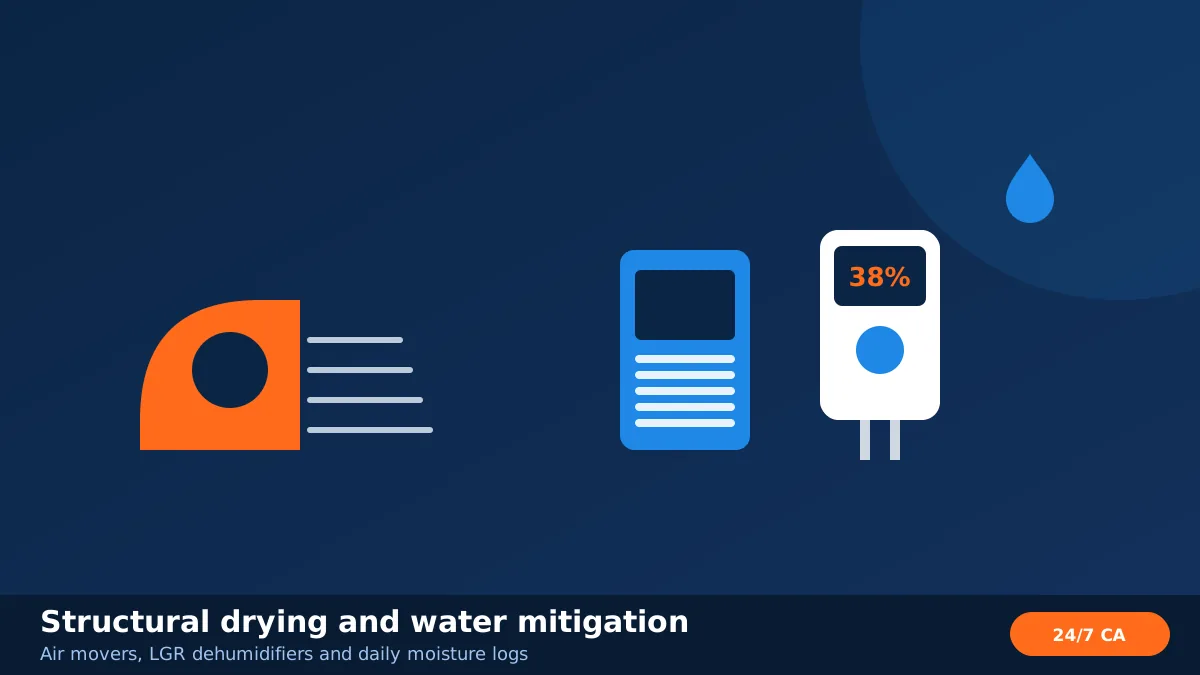
- Air movers push high-velocity air across floors and walls to speed evaporation.
- Dehumidifiers remove that evaporated moisture from the air so it does not settle back into materials.
- Temperature is kept in a range where evaporation stays efficient.
Crews track the air with a thermohygrometer, which reads temperature and relative humidity, and calculate grains per pound, a measure of how much water vapor the air holds. When the air inside is drier than the materials, water moves out of the materials.
LGR dehumidifiers vs. conventional
Low grain refrigerant (LGR) dehumidifiers keep pulling water out of the air at lower humidity levels than conventional units, which matters in the final days of a drying job when the easy water is gone. Desiccant dehumidifiers are used in some cases, such as cooler spaces and dense materials, because they work differently and are less affected by low temperatures.
Specialty drying systems
- Hardwood floor drying mats pull moisture up through the boards to limit cupping.
- Wall cavity injection pushes dry air into walls through small holes, sometimes avoiding a flood cut.
- Crawl space and subfloor drying uses directed airflow and dehumidification under the house.
- Concrete slab drying takes time, because concrete holds water deep in the slab.
How California's climate changes the drying plan
Drying follows physics, and California packs very different climates into one state.
| Region | What crews deal with | How drying changes |
|---|---|---|
| Coastal fog belt (San Francisco's Sunset and Richmond, Pacifica, Santa Cruz, Long Beach, coastal San Diego) | Humid marine air for much of the year | Closed containment and more dehumidification; outside air rarely helps |
| Inland valleys (Fresno, Riverside, Sacramento, the San Fernando Valley) | Dry, hot summers and cool winter nights | Fast evaporation in summer; temperature control matters in winter |
| Atmospheric river storms statewide | Days of rain, high outdoor humidity, roof and window leaks | Drying waits on source control, and outside air is not used |
| Hillside and canyon homes | Retaining walls, drainage, crawl spaces | Subfloor and crawl space drying, plus a drainage fix |
On dry, warm inland days, crews may use outside air to help. On a foggy coastal day or during a storm, bringing outside air in slows drying, so the home is closed up and dehumidified.
How long structural drying takes
Most homes dry in about three to five days after equipment is set. Factors that add time:
- Class 3 losses, where water came from above and soaked ceilings, walls, insulation and floors
- Class 4 materials: hardwood, plaster and lath, concrete, brick and crawl spaces
- Delayed response, where water had days to wick into walls
- Cabinets and built-ins that trap moisture behind and under them
- Older homes where asbestos or lead testing has to happen before materials are cut
Drying is finished when readings in wet areas match dry reference readings from unaffected areas of the same material. Ask to see those numbers.
Signs your home was not dried properly
- A musty smell that returns days or weeks later
- Baseboards or door casings swelling after the equipment left
- Hardwood that cups or crowns weeks after the loss
- Paint bubbling along the bottom of walls
- Dark spots on drywall paper or behind baseboards
Any of these after a water loss deserves a moisture check. Mold that starts because drying was cut short is a common source of disputes, and it is easier to prevent than to fix. See mold remediation if growth has started.
Water in your home or business right now? Call (213) 533-0446, 24/7. A real person answers and a licensed local crew is dispatched.
Call (213) 533-0446The drying log: what it should show
A proper drying log records, for each day:
- Date and time of the visit
- Readings at each mapped point, with the material and location
- Dry reference readings for each material type
- Indoor and outdoor temperature and relative humidity, plus grains per pound
- Equipment count and placement for air movers and dehumidifiers
- Changes made and why
- Photos of the moisture map and equipment
This is what adjusters look for. It also tells you exactly why the job took as long as it did.
What water mitigation and drying cost
LawnStarter's 2026 data puts water mitigation at roughly $3.15 to $7.40 per square foot nationally, inside an average full restoration job of $3,250, with most jobs between $1,270 and $5,376. Equipment is usually charged per unit per day, so the number of air movers and dehumidifiers, and the number of drying days, drive the price. Category 2 and 3 water, specialty hardwood drying and crawl space work cost more. Our cost guide has the full ranges, and California's price gouging law caps post-emergency increases at 10 percent.
Water mitigation and your insurance claim
Most homeowners policies cover mitigation for sudden and accidental losses and expect you to prevent further damage. Practical tips:
- Start mitigation right away. You do not have to wait for the adjuster to see standing water, as long as you photograph it first.
- Share the logs with your adjuster as the job progresses.
- Keep removed materials or photos of them until the adjuster says otherwise.
- Know your deadlines: under California's Fair Claims Settlement Practices Regulations, insurers must acknowledge a claim within 15 calendar days and accept or deny it within 40 calendar days of proof of claim.
The California Department of Insurance handles complaints if those deadlines are missed. More in our insurance guide.
Structural drying in your area
Crews handle drying for coastal condos in Long Beach and San Diego, foggy-side homes in San Francisco, crawl spaces in Sacramento and Oakland, and slab homes in Irvine, Riverside and Fresno.
How different materials dry
| Material | How it holds water | Typical approach |
|---|---|---|
| Drywall | Wicks water upward quickly | Dried in place if firm; cut above the wet line if swollen, soft or hiding wet insulation |
| Carpet and pad | Pad soaks and holds water | Carpet often dried in place; pad usually replaced |
| Hardwood | Absorbs water and cups as boards swell | Floor drying mats and dehumidification; some boards may need replacing |
| Plaster and lath | Dense and slow to release water | Longer drying, sometimes heat and specialty airflow |
| Concrete slab | Holds water deep inside | Extended dehumidification; flooring goes down only after readings are dry |
| Framing lumber | Dries well with airflow once exposed | Baseboards removed and cavities opened or injected |
| Cabinets | Trap water underneath and behind | Toe kicks removed or drilled; sometimes cabinets are pulled |
The reason crews map each material separately is that they dry at very different speeds. A room can have dry drywall and a still-wet slab under the carpet. The drying log should show readings for each.
Frequently asked questions about water mitigation and drying
How long do drying fans and dehumidifiers need to run?
Usually three to five days for most homes. The equipment stays until moisture readings in wet areas match dry reference readings, which can take longer for hardwood, plaster, concrete or crawl spaces.
Can I turn off the drying equipment at night?
It is best not to. Drying depends on continuous airflow and dehumidification. Turning equipment off lets humidity climb back up and adds days to the job.
Will running the equipment raise my electric bill?
Yes, somewhat. Air movers and dehumidifiers draw power around the clock. Keep a note of the drying days; some policies reimburse the extra cost.
Why did the crew cut holes in my walls?
To dry the wall cavity, remove wet insulation, or inject dry air. Small holes or a straight cut above the wet line are easier and cheaper to repair than mold inside a closed wall.
Is it okay to open windows to help drying?
Only when outside air is drier than inside air. On foggy coastal days or during storms, open windows slow drying. The crew decides based on humidity readings.
What is the difference between water mitigation and water remediation?
They are often used interchangeably. Mitigation usually means limiting damage from water. Remediation more often refers to removing a hazard, such as contaminated materials or mold.
Do I need structural drying for a small leak?
If water reached the inside of a wall, the subfloor or the pad under carpet, yes. A small leak in the wrong place can still lead to mold if only the surface is dried.