

Key takeaways
- Mold can start in 24 to 48 hours on wet drywall, wood and carpet pad.
- Fix the water first. Remediation without drying fails.
- Visible mold can make a rental substandard under California Health and Safety Code §17920.3.
- Insurance usually covers mold only when it follows a covered water loss, often with a dollar limit.
Mold is almost always a water problem wearing a different costume. It shows up behind a refrigerator after an ice maker line leaked for months, along the bottom of a wall after a slab leak, on the underside of a subfloor in a damp crawl space, or in a closet on the foggy side of San Francisco where the air never quite dries out. The visible growth is the symptom. The moisture is the cause.
This page explains how professional mold remediation works in California, the state rules that matter, what it costs, how insurance treats it and how to keep it from coming back. If you can see or smell mold after a water problem, call (213) 533-0446.
Water in your home or business right now? Call (213) 533-0446, 24/7. A real person answers and a licensed local crew is dispatched.
Call (213) 533-0446Signs you may have mold after water damage
- A musty or earthy smell that comes back after cleaning
- Dark spots or fuzzy growth on drywall, baseboards, ceilings or the backs of cabinets
- Paint bubbling or peeling near a known leak
- Warped or soft drywall, or baseboards pulling away from the wall
- Allergy-like symptoms that improve when you leave the house
- A past leak that was never professionally dried
If you are not sure whether there is hidden moisture, a moisture meter and thermal camera can usually tell in an hour. Mold you cannot see is often in the same places water travels: inside walls, under flooring and in crawl spaces.
How professional mold remediation works
1. Find and fix the moisture source
Every remediation starts with the water. That might be a slab leak, a burst pipe or water heater, a roof leak from an atmospheric river, condensation in a cold wall or a damp crawl space. If the source is not fixed, the mold comes back.
2. Assess the extent
Crews map moisture and visible growth and decide how far containment needs to go. For larger or more complicated cases, or when you want independent confirmation, a separate mold inspector or industrial hygienist can assess before and after.
3. Contain the area
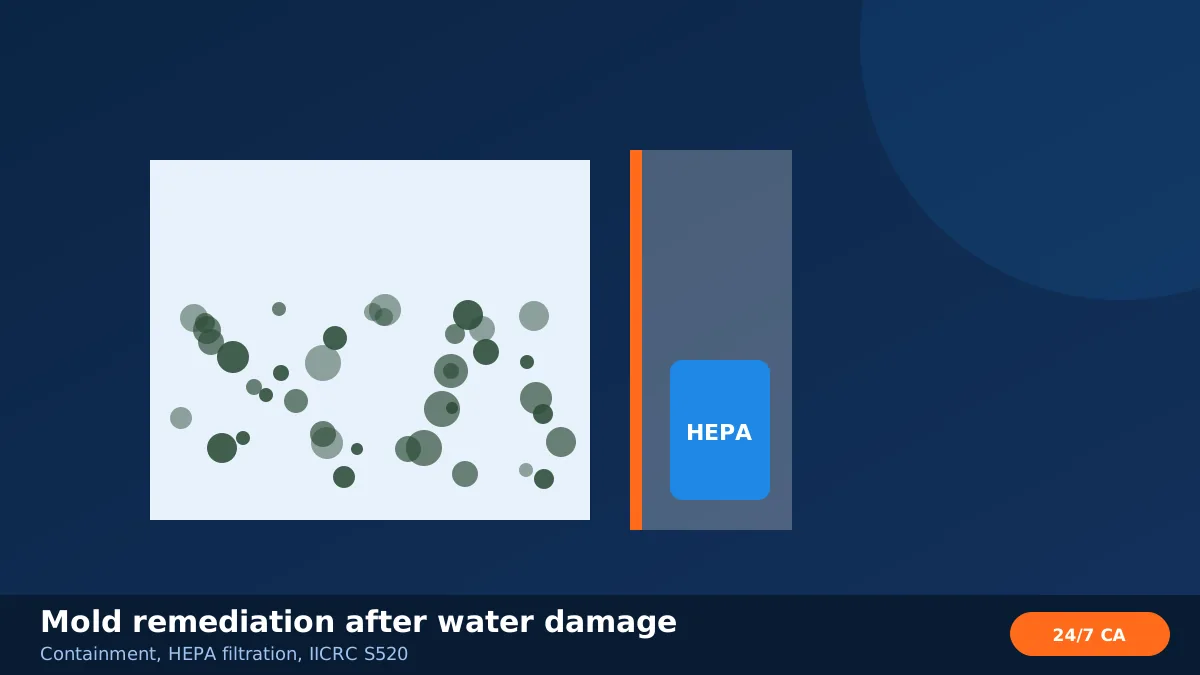
Plastic sheeting, zipper doors and negative air pressure keep spores from spreading to clean parts of the home during work. HVAC serving the area is shut off or sealed.
4. Filter the air
HEPA air scrubbers run throughout the job to capture airborne spores and dust.
5. Remove what cannot be cleaned
Moldy drywall, insulation, carpet pad and other porous materials are bagged inside the containment and removed. Structural wood with surface growth is usually cleaned rather than replaced.
6. Clean remaining surfaces
Framing and hard surfaces are cleaned, often with HEPA vacuuming and damp wiping, and sometimes sanding or media blasting for heavier growth on wood. IICRC S520 focuses on physically removing mold, not just spraying it.
7. Dry the structure
Structural drying brings materials back to a dry standard so new growth cannot start.
8. Verify, then rebuild
Visual inspection, moisture readings and, when called for, clearance testing by an independent professional confirm the area is clean before walls close up.
California mold rules worth knowing
- Mold can make housing substandard. SB 655 added visible or otherwise demonstrable mold growth, other than minor growth or growth caused by poor housekeeping, to the list of substandard housing conditions in Health and Safety Code §17920.3. Tenants can ask local code enforcement or the health officer to inspect.
- Mold is regulated locally. The Contractors State License Board notes that mold issues fall under local health agencies, so requirements vary by city and county.
- The California Department of Public Health's guidance treats indoor dampness and mold as health concerns and focuses on finding and fixing the moisture source. See the CDPH and the U.S. EPA mold guide.
- Contractor licensing still applies. Any job of $1,000 or more, or one that needs a permit, requires a CSLB-licensed contractor. Check the license at the CSLB website.
This page does not give medical advice. If you have health concerns, talk with your doctor.
Water in your home or business right now? Call (213) 533-0446, 24/7. A real person answers and a licensed local crew is dispatched.
Call (213) 533-0446Where mold shows up in California homes
| Region | Common mold sources |
|---|---|
| Coastal fog belt (San Francisco, Pacifica, Santa Cruz, coastal San Diego and Long Beach) | Chronic dampness, poor ventilation, closets on exterior walls, bathrooms without exhaust fans |
| Southern California slab homes (Irvine, the San Fernando Valley, Riverside) | Slab leaks wetting carpet pad and drywall along one wall |
| Inland heat (Fresno, Riverside, Sacramento) | Attic AC condensate line overflows and drain pan failures |
| Older Bay Area and Sacramento homes | Crawl space moisture and old galvanized pipe leaks inside walls |
| After atmospheric rivers statewide | Roof, window and stucco leaks that soaked insulation and framing |
What mold remediation costs
Homeyou's Berkeley estimates put mold remediation at roughly $500 to $10,000 depending on the affected area. Small, contained areas sit at the low end. Jobs involving several rooms, crawl spaces, attics, HVAC systems or structural framing sit at the high end. Independent testing, the underlying water repair and rebuild are often separate costs. See our cost guide.
Mold and insurance in California
- Covered peril, covered mold: many policies cover mold only when it results from a covered, sudden water loss, often with a sub-limit.
- Excluded: mold from long-term leaks, humidity, condensation and neglect is usually excluded.
- Delays hurt: insurers expect you to take reasonable steps to prevent further damage after a water loss. Prompt drying protects coverage.
- Document: keep moisture readings, photos, the cause of loss and any test results.
More in our California insurance guide.
How to keep mold from coming back
- Fix leaks the day you find them and dry everything that got wet
- Run bathroom exhaust fans during and after showers
- Keep indoor humidity in check, especially in coastal fog areas
- Clear attic AC condensate lines and check drain pans before summer
- Ventilate and inspect crawl spaces
- Keep gutters and downspouts flowing and soil away from stucco weep screed
Mold remediation in your area
Crews handle mold after water damage in San Francisco and Oakland homes with chronic dampness, slab homes in Irvine and Los Angeles, and attic condensate losses in Fresno, Riverside and Sacramento.
What a mold remediation estimate should include
A good estimate explains the job, not just the price. Look for:
- The moisture source and how it will be fixed, or who will fix it
- The affected area in square feet, with rooms and surfaces listed
- Containment details: sheeting, zipper doors, negative air pressure
- Air filtration: number of HEPA air scrubbers and how long they run
- Removal of specific materials, such as drywall to a set height, insulation or carpet pad
- Cleaning methods for framing and other surfaces that stay
- Drying plan and readings
- Verification: how the area will be confirmed clean, and whether independent clearance testing is included or recommended
- Rebuild, if included, listed separately
If an estimate offers only spraying or fogging without removal or drying, ask why. Physical removal and fixing the moisture are what prevent regrowth.
If you rent
Tell your landlord in writing as soon as you see mold or a leak, and keep photos and copies. Report new leaks right away. Keeping the place ventilated and running exhaust fans helps, but persistent mold from leaks or building defects is the landlord's job to fix. If it is not addressed, local code enforcement or the health officer can inspect.
Frequently asked questions about mold remediation
How fast does mold grow after water damage?
Mold can start growing on wet materials within 24 to 48 hours. That is why prompt extraction and drying matter so much.
Can I remove mold myself?
Small areas of surface mold on hard surfaces can often be cleaned by homeowners. Larger areas, mold inside walls, mold after sewage or floodwater, or mold in a home with vulnerable occupants are better handled by professionals with containment and HEPA filtration.
Does bleach kill mold?
Bleach can lighten mold on hard surfaces but does not solve the problem in porous materials like drywall, and it does nothing about the moisture source. Professional remediation focuses on physical removal and drying.
Do I need mold testing?
Not always. If mold is visible and the source is known, testing often does not change the plan. Testing is useful for hidden mold, for health-sensitive households, for real estate transactions and for clearance after remediation.
Does insurance cover mold remediation in California?
Sometimes, when the mold resulted from a covered sudden water loss, and often with a dollar limit. Mold from long-term leaks or humidity is usually excluded.
My landlord will not fix mold. What can I do?
Notify the landlord in writing and keep photos. Visible mold that is not minor can be a substandard housing condition under California Health and Safety Code §17920.3, and local code enforcement or the health officer can inspect.
Will mold come back after remediation?
Not if the moisture source is fixed and the structure is properly dried. Mold returns when water returns.
How long does mold remediation take?
Small, contained jobs often take one to three days. Larger jobs involving several rooms, crawl spaces or attics take longer, and drying plus any clearance testing add time before walls are closed up. The crew should give you a written schedule with the estimate.